


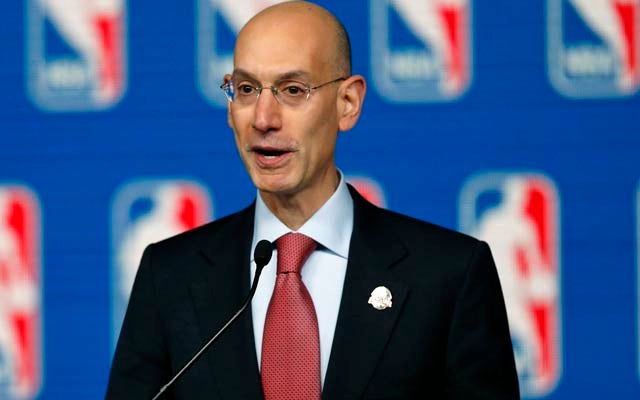
 New commissioner Adam Silver addresses the media on the eve of the All-Star Game (USATSI)
NEW ORLEANS -- In contrast to David Stern's dry, detached manner, Adam Silver opened his first All-Star address with a personal touch.
He spoke from the heart about how he grew up with the game, and how it helped him bond with his father after his parents were divorced. He spoke about being a student at Duke, and having his relationship with basketball grow from there.
Borrowing from presidential politics, Silver at one point reached into his blazer pocket and pulled out a letter from former NBA player and coach Sam Vincent, who wrote to Silver about the importance of the league to those who've made it their life's work.
"Where would we all be without the NBA?" Vincent wrote.
And then, Silver proceeded to the part of the job that Stern enjoyed so much -- the part that is all his, now. Answering the questions, solving the problems, fighting the battles that will be there to fight every day of his commissionership.
Welcome to the hot seat, Commissioner Silver.
"This is a fabulous league that still has his best years ahead of it," Silver said on Saturday night.
It was difficult to pluck a headline from Silver's first-go-round as the voice of the league at its signature event. More noteworthy than anything Silver said was where he was positioned while saying it -- standing at a single lectern, as opposed to seated next to Stern, as he was in recent years. Instead of a static, lifeless curtain behind him, Silver stood in front of a giant, pixelated blue background -- emblematic of how he embraces technology and trying something new.
Some highlights of Silver's first All-Star news conference as commissioner:
-- He explained his reasoning for wanting to raise the NBA's age limit to 20 (with an implied two-year minimum stay in college), saying it would "lead to stronger college basketball and stronger NBA ball as well. ... It is my belief that if players have an opportunity to mature as players and as people, for a longer amount of time before they come into the league, it will lead to a better league."
-- To accomplish that goal, Silver would have to negotiate it with the National Basketball Players Association, which still does not have a permanent replacement for ousted executive director Billy Hunter. Silver said the lack of a bargaining counterpart "is a hindrance to a certain extent. I would love to have a partner across the table that had the backing of the entire players' association and with whom we could do business. ... I'm looking forward to dealing with a partner in this league -- a partner, not an adversary -- a partner that's going to continue to build this league with me."
-- Silver said the unpopular sleeved jerseys, which the All Stars will wear on Sunday, are selling well in the stores -- if not among all the players. "Player feedback has been mixed," Silver said. The jerseys are "something we're trying. ... Long term, we'll see. But it was never the intention or Adidas' intention to change the core uniform that our players wear."
-- Silver said the league will continue to evaluate injury rates as they may be related to the length of the regular season or the preponderance of back-to-backs and stretches of four games in five nights. The idea of a longer, mid-season All-Star break for players has been discussed.
-- When asked what innovations he plans to bring to the league, Silver mentioned two key words: technology and transparency. "Transparency in how decisions are made at the league office, transparency in how we deal with our players and the players' association," he said. "That's one of my guiding principles coming in."
-- In refuting the notion of tanking, Silver said, "There's no question that several teams are building towards the future." As far as changing the lottery system to discourage tanking, Silver said, "We've adjusted it several times over the years, and we'll adjust it again as necessary."
-- Asked to cite examples of small-market or low-revenue teams that have become more competitive under the new CBA -- other than San Antonio, Oklahoma City and Indiana, who were already on a successful path -- Silver reiterated his position that Miami is not a major market and mentioned Portland as a team that has rebuilt under the new rules. "Fortunes can change quickly," Silver said. "I think the fact that we had four teams in the conference finals last year who are all in the bottom half of the league in terms of market size is a strong indication that the collective bargaining agreement is working in terms of the correlation between market size and success."
-- Asked about international expansion, Silver said, "It's not on the top of my list right now, and I tell you that goes for domestic expansion as well -- largely because I want to ensure that we have a healthy 30-team league. As powerful as the gains were that we made in the last collective bargaining agreement, we still don't have a league that has 30 teams that are financially viable."
 Before joining CBSSports.com, Ken Berger covered the NBA for Newsday. The Long Island, N.Y., native has also worked for the Associated Press and can be seen on SportsNet New York. Catch Ken every Saturday, when he hosts Eye on Basketball from 6-8 p.m. ET on cbssportsradio.com
Basketball Hot News
Karl Malone is a big Anthony Davis fan
NEW ORLEANS — Right now it’s a serious debate about who is the best power forward in the game — LaMarcus Aldridge and Kevin Love lead most lists, Blake Griffin is trying to muscle in on the list, but guys like Tim Duncan and Dirk Nowitzki still have a say in the matter.
If five years it will not be a discussion, the answer will be Anthony Davis.
Among Davis’ fans is arguably the greatest power forward of all time, Hall of Famer Karl Malone.
“I see a young man that has just flourished here, he’s embraced it, he’s worked hard,” Malone said, speaking to media during All-Star Weekend. “I get to see the Pelicans play a lot, they being on T.V and me living in Louisiana. He don’t get too excited about things, he just goes out and plays the game. He plays hard.
“I’ll be the first to admit this… when they first drafted him I wasn’t totally for sure (sold on him) because I hadn’t seen how he played with his teammates. You can truly build a great team around this young man. I love to see him play and I love the way he keeps his composure and just plays the game.”
Malone’s game was a mix of physical play and great touch — he could pass, his mid-range jumper was deadly. He sees a little of himself in the current crop of power forwards.
“They’re shooting a lot better than I did,” Malone laughed. “Kevin Love, LaMarcus (Aldridge), Blake Griffin playing on top of the rim, to me they are power forward/small forwards with the things they can do. Like I said, I love to watch them. Tim Duncan, you can call him a forward or center, I just like to see him play, it don’t matter what position he plays.
“I think the power forward position is in good hands for a lot of years.”
He’s right. And in a few years it may well be Anthony Davis then everyone else at the spot.

 Posts
Posts


0 comments:
Post a Comment